
Criminal Court Records in Ottawa County
A criminal court record is the official case file the Court Clerk opens when prosecutors file charges. The clerk records, files, and keeps permanent records of District Court proceedings. The file grows as the case moves forward. Each filing, hearing, and order gets logged on the docket. By the end, the record shows the charges as filed, every court date, the plea or verdict, and the sentence. This case-level file is not the same as a jail booking sheet or a statewide criminal-history report. It is the court's own account of what happened in the courtroom.
In Ottawa County, the District Court is the trial court for state crimes. It hears felony cases, marked with a CF prefix on the case number, and misdemeanor cases, marked CM. Felonies are the more serious crimes that can carry prison time. Misdemeanors carry lighter penalties, often fines or a short county jail term. City ordinance violations are handled separately by Miami Municipal Court, not the District Court. Tribal courts near Ottawa County and the federal court for the Northern District of Oklahoma run their own systems. A case heard in one of those courts will not show up in the county District Court file.
How to Search Ottawa County Criminal Court Records
The county routes court-record searches to On Demand Court Records, known as ODCR. The Court Clerk page and the county homepage both link to it as the Search Court Records tool. ODCR carries Ottawa County District Court dockets, including criminal felony and misdemeanor cases. Searching and viewing docket information is free. Document images are another matter. ODCR limits Oklahoma District Court images to active members of state bar associations, so the public can read the docket but may not download the filed papers online.
- Open the ODCR court search and set the court to Ottawa.
- Enter the defendant name in Last, First format, or type a full case number.
- Narrow by party type, case type such as criminal felony or misdemeanor, and a filed-date range.
- Open a case result to read the case information, the offense or cause, the parties, and the case entries.
- Contact the Court Clerk for a certified copy, an older file, or any record not visible online.
The Oklahoma State Courts Network, or OSCN, is the statewide court-record site. It offers a case-number lookup and points users to ODCR for non-OSCN counties like Ottawa. For someone sentenced to state prison, the Oklahoma Department of Corrections runs a separate offender lookup. Each system has a different custodian, so a full search may take more than one stop.
Stages of a Criminal Case in Ottawa County
A criminal case moves through set stages, and each one leaves a mark on the record. The docket lists them in order by date. Reading the entries from top to bottom shows how the case unfolded. Some cases end fast with a plea. Others run for months through motions and hearings before a disposition lands.
Case flow: Charges Filed › Arraignment › Pretrial / Motions › Plea or Trial › Disposition › Sentencing
| Stage | What Happens |
|---|---|
| Arraignment | The defendant hears the charges in open court and enters a plea of guilty, not guilty, or no contest. |
| Pretrial / Motions | Lawyers set bond, file motions, and trade evidence; a felony may get a preliminary hearing to test probable cause. |
| Plea or Trial | The case ends in a plea deal, or it goes to trial where a judge or jury decides guilt. |
| Sentencing | After a plea or verdict, the judge imposes the penalty, which can include jail, prison, fines, probation, or a deferred or suspended term. |
Note: A felony case often opens with a probable cause affidavit and a preliminary hearing, while a misdemeanor usually moves straight to arraignment and plea.
What an Ottawa County Criminal Court Record Shows
A criminal case file in Ottawa County packs a lot of detail into one docket. The header names the case and the parties. The body lists every charge, count by count, with its status. Below that, the case entries log each filing and hearing by date. Many criminal files also carry a running tally of court costs and fees tied to statutory line items.
| Field | What It Shows |
|---|---|
| Case Number | County and case type code with year and sequence, such as CF-2012-00242 for an Ottawa felony. |
| Filed Date | The date the State filed the case in District Court. |
| Defendant | Name and city or state of the person charged, listed as State of Oklahoma versus that person. |
| Charges | Each count of the offense or cause, with wording and a status line such as guilty plea or dismissed. |
| Parties | Defendant, the District Attorney, defense counsel or public defender, and the assigned judge. |
| Plea | How the defendant answered the charge, entered at arraignment or later. |
| Case Entries | Dated log of filings, hearings, orders, warrants, payments, and continuances. |
| Disposition | The current or final result of each count. |
| Sentence | The penalty imposed after a conviction, including jail, fines, probation, or a deferred term. |
Charges vs. Convictions
A charge is an accusation. A conviction is a proven result. The two are easy to mix up in a record, but the gap between them matters. A criminal court file can show charges that were later dropped, dismissed, or that ended in an acquittal. None of those is a conviction. Prosecutors file charges on probable cause, a fairly low bar. A conviction needs proof beyond a reasonable doubt, the highest standard in law. Reading the disposition line for each count is the only sure way to tell which charges led to a conviction.
| Charge | Conviction | |
|---|---|---|
| Stage | Accusation | Verdict or plea |
| Burden of Proof | Probable cause | Beyond reasonable doubt |
| Can Be Dropped | Yes, dismissed or amended | Stands unless appealed |
| Public Record | Yes | Yes |
Reading Dispositions and Sentences
The disposition is the bottom line for each count. In Ottawa County files, you may see plain language like guilty plea, dismissed, or application to revoke. A guilty plea means the defendant admitted the charge. Dismissed means that count ended without a conviction. A deferred sentence can end in dismissal if the defendant meets every condition. A suspended sentence is served outside custody as long as the terms hold. Probation is court supervision in place of, or after, jail time.
For sentences that send a person to state prison, the court file is not the end of the trail. The Oklahoma Department of Corrections runs an online offender lookup at its offender records portal for people in its custody.
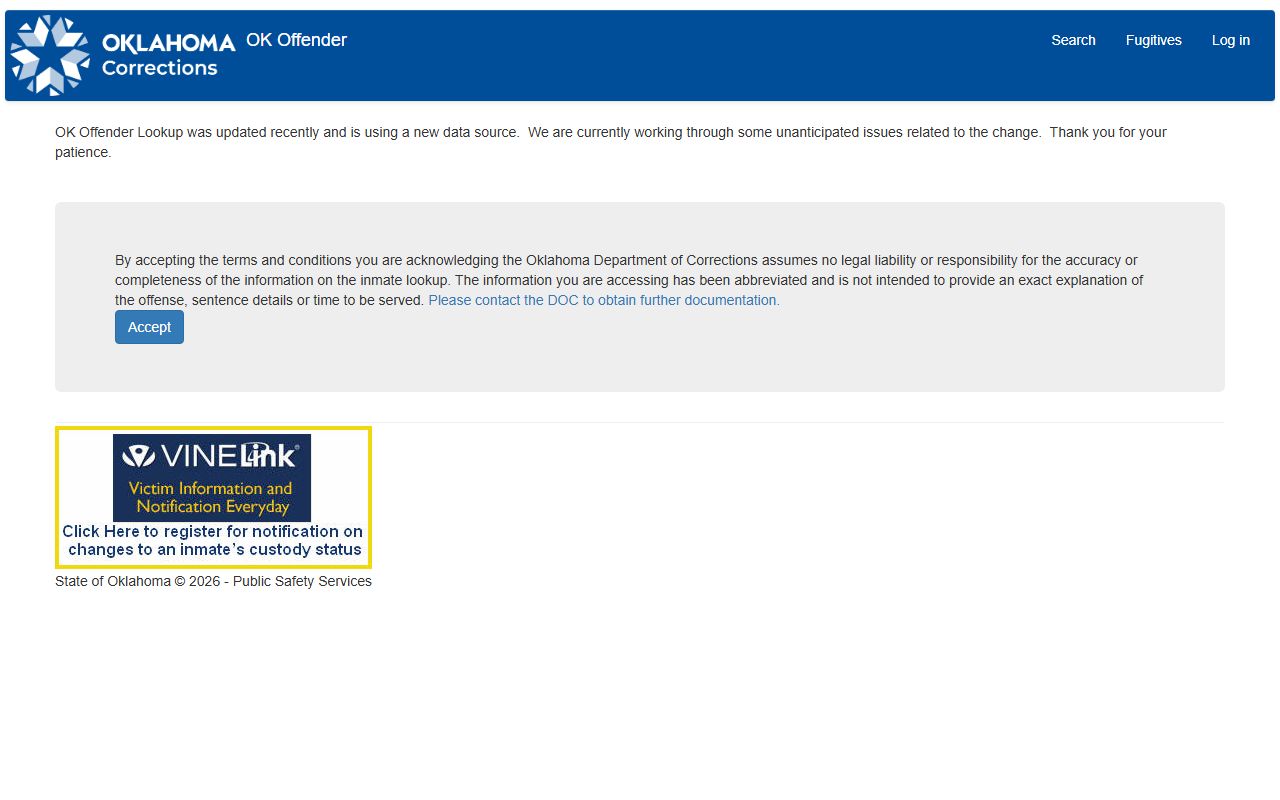
That tool confirms a state sentence after the county case closes, yet it stays separate from the District Court record and the county jail roster. Always tie the prison record back to the case number in the court docket.
Sealed vs. Expunged Records
Some criminal records are pulled from public view. Oklahoma uses two related tools: sealing and expungement. Sealing hides a record from the public while a limited set of officials keeps access. Expungement goes further and treats the record as though it never existed for most purposes. The Court of Criminal Appeals sets the procedure for sealing and redaction by court order.
The Court of Criminal Appeals lays out the sealing and redaction steps in Rule 2.7, which ties the process to the state open-records law.
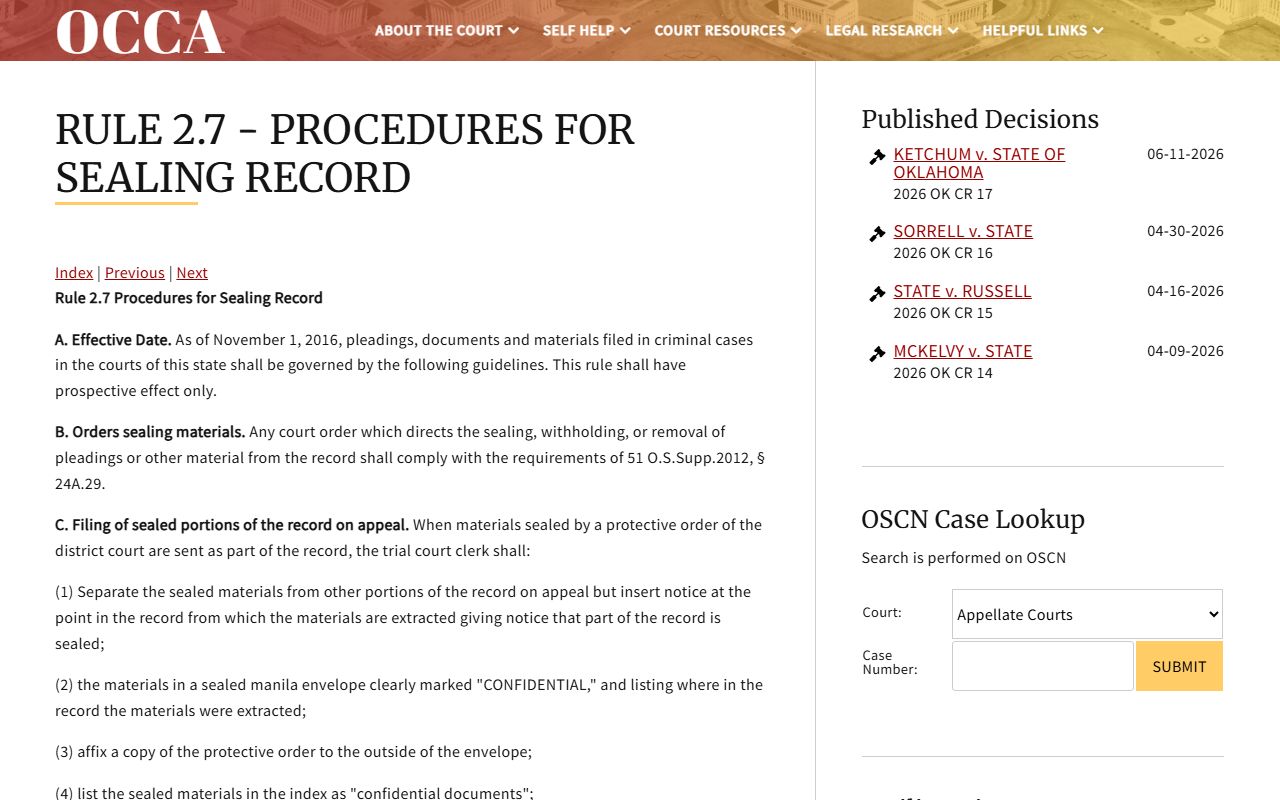
Under that rule, a person files a motion, states the legal grounds, and asks the judge to seal the qualifying court and law-enforcement records. Eligibility is not automatic. The Oklahoma State Bureau of Investigation cannot pre-approve an expungement and points people to the categories in Title 22, Section 18 of the state statutes. A deferred sentence may produce a different record result than a full expungement.
| Sealed | Expunged | |
|---|---|---|
| Visibility | Hidden from public | Treated as never existed |
| Law Enforcement | Limited access | Very limited |
| How It Happens | Court order under Rule 2.7 | Petition under Title 22, Section 18 |
| Eligibility | Set by court order and grounds | OSBI cannot pre-approve; statute controls |
Note: Filing for expungement does not guarantee it, since the court weighs the case outcome, any waiting period, and whether charges are still pending.
Public Access to Ottawa County Criminal Court Records
Criminal court files are public by default in Oklahoma. The Oklahoma Open Records Act sets a policy that favors access so people can stay informed about their government. Records stay open unless a statute makes them confidential. The first route is the online court system the Court Clerk links, with the clerk's office as the backup for anything not online. When a docket is confusing or an image is restricted, the Court Clerk is the records office for District Court files.
Key Statutes:
Oklahoma Open Records Act, 51 O.S. § 24A.1 - names and establishes the state's open-records framework.
51 O.S. § 24A.5 - keeps public records open unless a statute makes them confidential.
Court of Criminal Appeals Rule 2.6 - the online docket is a public convenience and does not replace the official court file.
Background Check Considerations
A casual ODCR search is not a background check. Employers, landlords, and lenders that make decisions about a person must follow the federal Fair Credit Reporting Act and use a regulated screening company. Court dockets can be incomplete. They can lag behind recent filings, and they leave out sealed or expunged matters. A name match is not proof of identity, since two people can share a name. For any decision with legal weight, a certified record from the Court Clerk or a compliant screening service is the safer source.
Important: This site is not a consumer reporting agency under the FCRA, and its information may not be used for employment, credit, tenant, or insurance screening.
Restricted Criminal Court Records in Ottawa County
Not every criminal matter is open. Juvenile cases are commonly confidential and limited to parties, attorneys, and authorized agencies. Sealed and expunged cases drop out of public view by court order. Records that hold protected identifiers, such as Social Security numbers or a minor's name, get redacted. Some mental-health filings are partly sealed. Active investigations and law-enforcement-sensitive material can be withheld even when a case is otherwise public.
The county criminal court file focuses on the case itself. For a closer look at the charges as the prosecutor filed them, the Ottawa County arrest records and charges page goes deeper, and the broader Ottawa County court records page covers civil, family, and probate files. Booking status before a case opens sits with the jail, not the court.