
Ottawa County Arrest Records and Charges
An arrest record is the account of an arrest itself. In Ottawa County, that means a sheriff's deputy, a Miami police officer, or another agency took a person into custody and booked them. The record shows who made the arrest, when it happened, and the offenses the person was booked on. Booking charges are not the final word. A jailer lists what someone was brought in for. The District Attorney then reviews the case and decides the formal charges to file with the Court Clerk. Once those charges are filed, they become the court charge record, and the case begins.
These are two records held by two offices. The arrest and booking side sits with the Ottawa County Sheriff's Office and the county jail, which run the inmate roster and the daily booking reports. To see who is in custody and what they were booked on, the Ottawa County inmate records page covers the jail roster and booking detail. The court charges after arrest sit with the Court Clerk, who files and keeps the case. Charges can shift between the booking list and the filed list. The full case file, with pleas, hearings, and the final outcome, lives in the Ottawa County criminal court records.
The Sheriff posts a running list of recent bookings online. The Ottawa County daily booking report shows people booked into the county jail with the charges listed at intake.
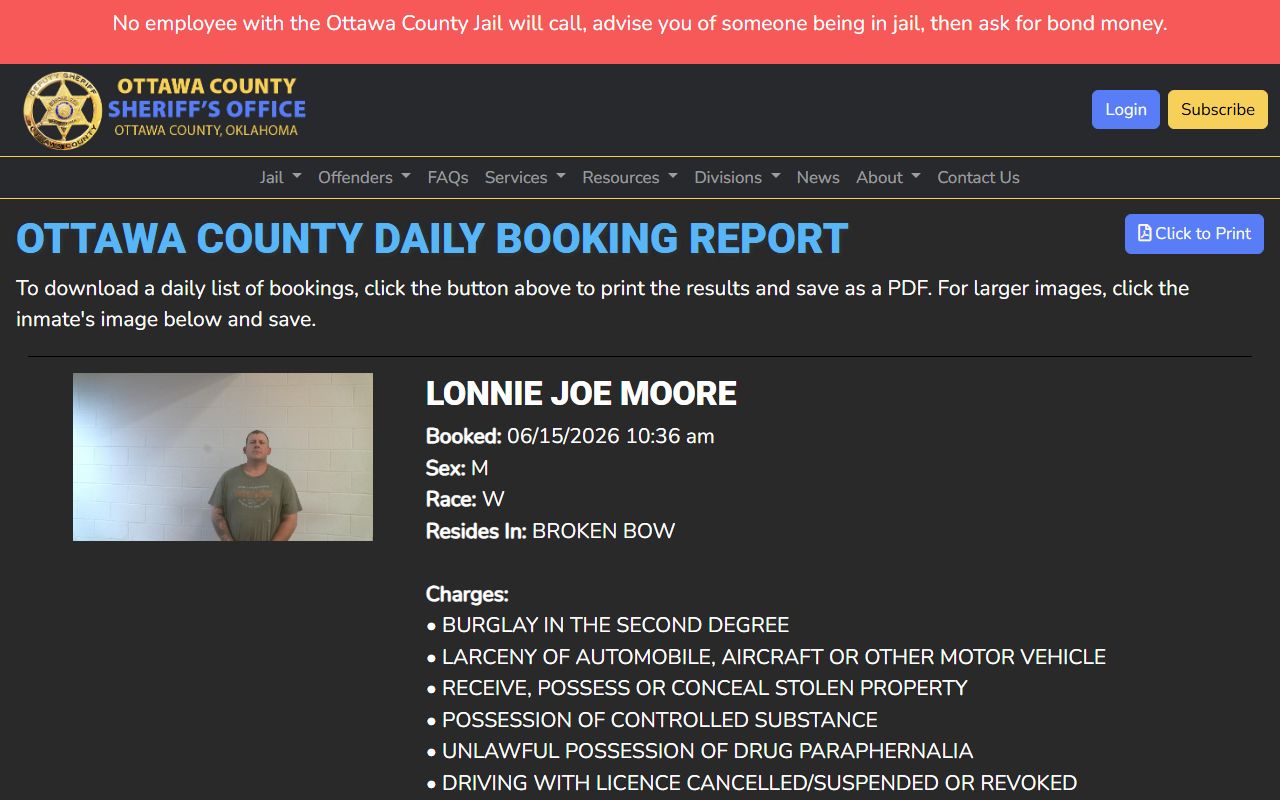
Those booking charges are a starting point, not the charges a court will rule on. The prosecutor can keep them, change them, or decline to file.
Find Ottawa County Arrest Records
Filed charges show up in the court case record. Oklahoma's main public court search is On Demand Court Records, known as ODCR, which the Court Clerk links as the way to look up Ottawa County cases. The Oklahoma State Courts Network, or OSCN, is the statewide docket system and points non-OSCN counties back to ODCR. To read the charges in a case, search by the defendant's name or the case number, then open the case.
- Open the ODCR court search or the Court Clerk's "Search Court Records" link, and set the court to Ottawa.
- Enter the party name in "Last, First" format, or type a full case number. Partial name searches work.
- Open the case result and read the "Offense or Cause" section, which lists each charge count by count.
- Check every charge for its statute code, severity level, and current status, such as guilty plea or dismissed.
Booking detail that is not in the court file may come from the Sheriff instead. Charges roll up into a statewide criminal history through the OSCN court records system and the state bureau that runs record checks, both covered further below. For older or sealed cases, the Court Clerk is the office to call.
Note: ODCR shows the filed charges and docket, but Oklahoma District Court document images stay limited to active members of the state bar.
How Ottawa County Charges Get Filed
The court charge record begins when the State files a charging document. After booking, the District Attorney reviews the police reports and the probable cause affidavit, then decides what to file. In Ottawa County the District Attorney is Douglas S. Pewitt, and his office brings the State's charges. Oklahoma uses three main charging documents. The one used depends on how serious the crime is and how the case reaches the court.
| Complaint | Information | Indictment | |
|---|---|---|---|
| Filed By | Officer / Prosecutor | Prosecutor | Grand Jury |
| Common For | Misdemeanors | Many felonies | Serious felonies |
| Starts | The case | The case | The case |
Many Ottawa County arrests start with a city agency. The Miami Police Department books arrestees and forwards reports that the prosecutor uses to decide charges.
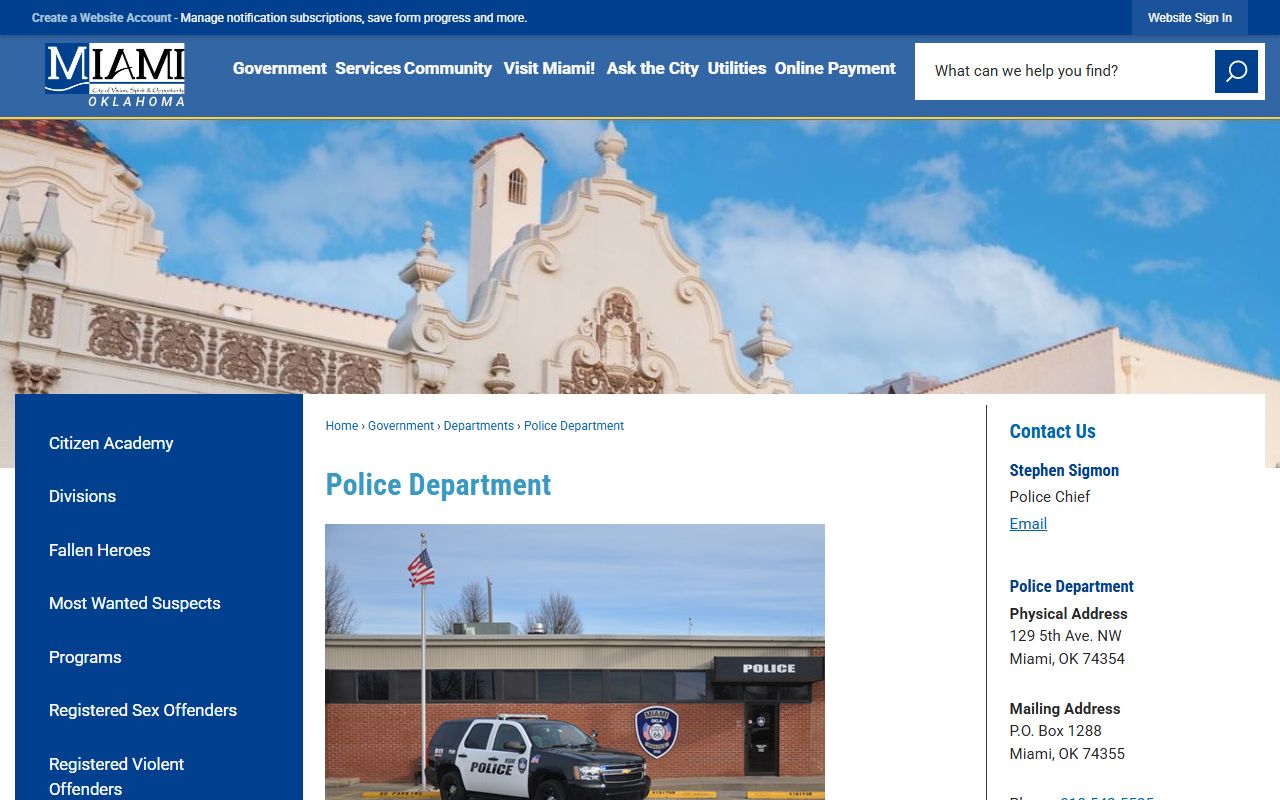
Once the District Attorney files, the matter moves from a police booking to a court charge record. The probable cause affidavit, the sworn facts behind the charge, usually appears in the case entries.
From there the case picks up early hearings. A felony filed by information moves through a preliminary hearing, the screening stage where a judge decides if the charges should stand. Bond gets set, defense counsel or a public defender is appointed, and the first appearance, the arraignment, fixes the formal plea. Each of these steps shows up as a dated entry in the Ottawa County case record, right alongside the charge itself, so the docket reads as a running history of what the charges have done since the arrest.
Ottawa County Charge Status Explained
Charges rarely stay frozen. As a case moves, the State can amend a charge, reduce it, add a count, or drop it. The court can dismiss a charge outright. Reading the status tells a searcher where a charge stands today. ODCR shows this in the offense lines and the case entries, often with short codes next to each count.
| Status | What It Means |
|---|---|
| Pending | The charge is filed and the case is open. No final ruling has been entered yet. |
| Amended / Reduced | The State changed the charge, often to a lesser offense or a corrected statute. |
| Dismissed | The charge ended without a conviction on that count, by the court or at the State's request. |
| Nolle Prosequi | Latin for "will not prosecute." The State chose to drop the charge. |
| Guilty Plea | The defendant admitted the charge, which becomes a conviction unless the sentence is deferred. |
Other entries touch a charge without changing the count itself. An application to revoke asks the court to enforce a suspended sentence after a claimed violation. A bench warrant can issue when a defendant fails to appear. ODCR case entries in Ottawa County cases show these moves with short notes, dates, and any fees, so the status of a charge is read from the whole timeline, not one line.
Charges vs. Convictions in Ottawa County
Being charged is not the same as being guilty. A charge is an accusation the State must still prove. A conviction is the result, after a plea or a verdict. An Ottawa County arrest record and a filed charge both appear in public records long before any court decides guilt. Treating a charge as a conviction is a common and serious mistake.
| Charge | Conviction | |
|---|---|---|
| Stage | Accusation | Verdict or plea |
| Burden of Proof | Probable cause | Beyond reasonable doubt |
| Public Record | Yes | Yes |
Note: A filed charge is only an accusation, and Oklahoma law treats a person as innocent until a plea or verdict settles the case.
Sealed vs. Expunged Records
Some charge records leave public view. Oklahoma law lets people seal or expunge qualifying records. Sealing hides a record from public access. Expungement goes further and treats the record as if it never existed. The Oklahoma State Bureau of Investigation handles criminal-history expungement and points to the eligibility categories in state law. It cannot pre-approve eligibility.
| Sealed | Expunged | |
|---|---|---|
| Visibility | Hidden from public | Destroyed / treated as never existed |
| Law Enforcement | Limited access | Very limited |
| Eligibility | By court order under the Open Records Act | Title 22, Section 18 categories; no pre-approval |
Ottawa County Charge Codes
Each charge ties to a statute. The code on a charge points to the exact law the State says was broken. Oklahoma sorts crimes by severity. A felony is the most serious level. A misdemeanor is lower. Many minor matters are handled as traffic counts or city ordinance violations. One arrest can produce several charges at once. A single booking might list a felony, a misdemeanor, and a traffic count, each filed and tracked as its own count in the same case.
Case-number prefixes in Ottawa County District Court signal the charge level at a glance:
- CF marks felony cases, the most serious charges.
- CM marks misdemeanor cases.
- TR marks traffic cases filed at the county level.
- CS and SC mark civil and small-claims matters, which are not crimes.
The severity level drives almost everything that follows, from bond to the possible sentence. A reduced charge can move a case from a felony prefix toward a misdemeanor one.
Statewide Charge and Criminal History Lookups
A single case shows only one set of charges. A statewide criminal history pulls a person's records together across counties. In Oklahoma, the Oklahoma State Bureau of Investigation runs criminal-history record checks for the state. It is the agency that compiles arrests and charges into one record, and it is the office to use when a single docket is not enough. Driving offenses follow a separate track through the state driver record.
Driving charges also leave a mark on that record. The Service Oklahoma motor vehicle report portal lets a person request their own record, or another person's record with legal authority.
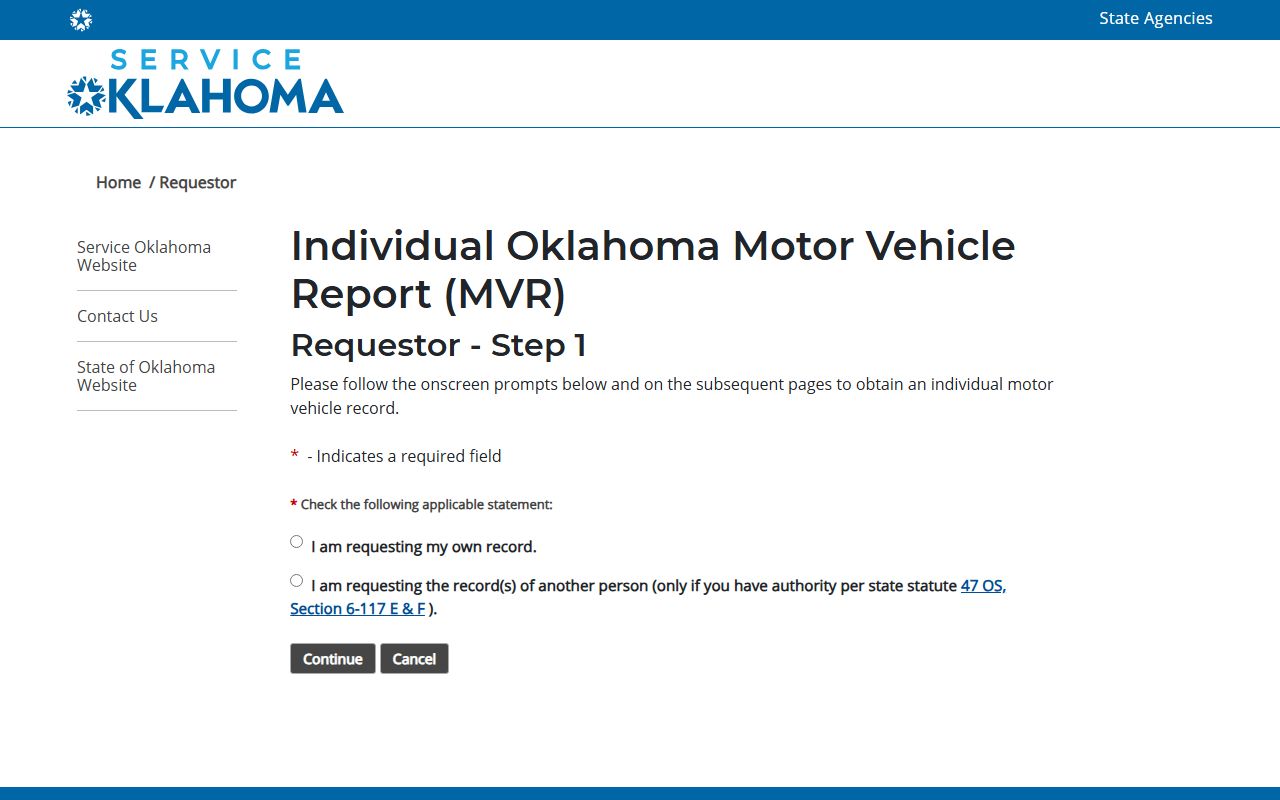
That driver record is not the court charge file. The two are kept by different offices and serve different purposes, so a clean docket does not always mean a clean driving history.
Note: A state driver record from Service Oklahoma is separate from the court charge file and is kept by a different office.
Background Check Considerations
Casual lookups and formal background checks are not the same thing. Searching a name on a court portal gives a quick read of filed charges. A formal background check for a job, a rental, or a license must follow federal rules under the Fair Credit Reporting Act. Those reports come from regulated agencies, not from a public docket glance. Court and arrest records found online can be incomplete or out of date, so a hiring or housing decision needs a compliant source.
Important: This site is a public records resource, not a consumer reporting agency under the FCRA, and its information cannot be used for credit, employment, tenant, or insurance decisions.
Restricted Ottawa County Charge Records
Not every charge record is open. Oklahoma's Open Records Act makes most court records public, but it carves out exceptions. Juvenile charges are usually confidential. Sealed and expunged charges drop out of public view by court order. Dismissed charges may still sit in the case file, though they can be expunged later. Records tied to an open investigation can be withheld. Protected details, such as Social Security numbers and the names of minors, are redacted from the public view.
Records the online portals do not show may still be available by request. The Ottawa County Sheriff's records request page takes open-records requests for booking and incident records, subject to fees and exemptions.
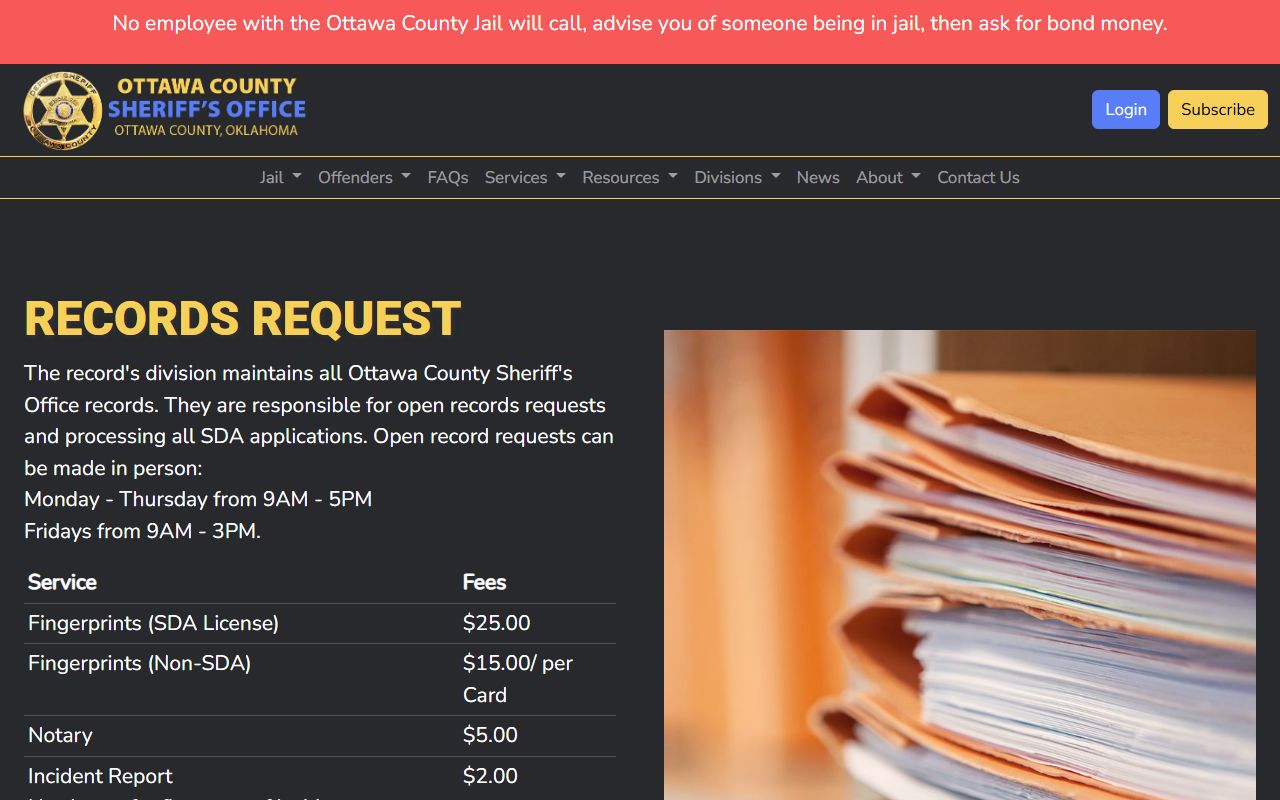
The form warns requesters not to send money until the office confirms the exact copying fee. For court charge documents themselves, the Court Clerk is the office of record, and sealed or juvenile matters will not be released to the general public.